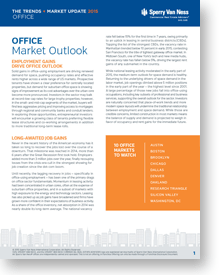
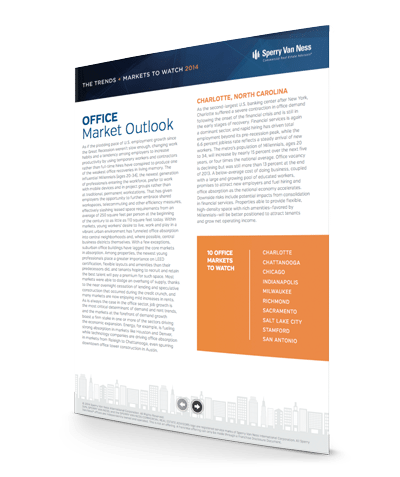
SVNIC’s 2016 Market Outlook Reports assess the current state of the national commercial real estate market, and identify micro-trends within specific geographic regions and industries for 2016. Today we are delving into the 2016 Top Office Markets to Watch. Not the largest or the most actively contested markets, the 2016 Office Markets to Watch are each at an important juncture that presents unique opportunities for investment. Together, they reflect the diversity of trends that is driving the economy and commercial real estate performance in markets across the country.
Top Office Market to Watch: San Francisco, CA
 San Francisco remains one of the hottest office markets in North America, led by booms in the tech industry that are seeking urban locations over sprawling campus sites. As such, the Bay Area has some of the highest rents and lowest vacancies and this trend is not forecast to reverse anytime soon. The overall economy is very healthy for the size of this metro, with unemployment at 3.9% as of January ‘16, according to the Bureau of Labor Statistics. Office-using sectors are some of the fastest growing, with Professional and Business Services, Information, and Financial Activities growing at 5.4%, 4.8%, and 1.3% annualized rates, respectively. Affordability of office space, as well as overall cost of living and operating, are the biggest impediments to sustained growth; thus, expect the suburbs to grow and urbanize at increasing rates as well.
Stay Updated…
Over the next few weeks, the SVN Blog will be featuring posts that will focus on each of the top markets to watch for industrial, multifamily, office, and retail properties. SVN Advisors from selected top markets have provided their industry expertise regarding what to look out for in their specific market in the coming months. Don’t miss out on these important insights – subscribe to the SVN Blog on the right side of the blog homepage.
To read more on other top office markets, download the full version of the 2016 Office Market Outlook report here.

[bctt tweet=”San Francisco, CA is one of 2016’s top office #CRE markets to watch.” username=”svnic”]
 San Francisco has been the iconic American boomtown for centuries and this trend continues today as technology firms have helped lead record job growth that has brought the unemployment rate down to 3.9% in January ‘16 as employment continues to grow at a 3.6% annualized rate, according to the Bureau of Labor Statistics. San Francisco is also a major port and tourist destination, thus the demand for retail real estate should grow strongly in 2016 and beyond. According to the Census Bureau, population has grown by 5.9% from 2010 to 2014, which is quite impressive given the limited land mass of the city and topography of the Bay Area. As rents and home prices rise, expect San Francisco retail real estate to continue gentrifying as well, causing rent spikes in many sub markets.
 San Jose is one of the hottest cities in the Bay Area and thus has experienced very strong employment growth since 2011 which has brought the unemployment rate down to 3.9% as of January ‘16 while jobs are still being created at the robust pace of 3.8% annualized according to the Bureau of Labor Statistics. Population growth is also significant at 6.6% from 2010 to 2014 as people find this market relatively more affordable. The San Jose housing stock is traditionally owner oriented with only 43% used for rentals. Given the rate of regional growth, local multifamily assets are very well positioned to pick up demand from surrounding areas a well as localized growth. Rent growth is expected to exceed 5% with relatively low new supply in 2016. Top sectors in job creation include Construction, Information, and Professional and Business Services with annualized growth rates of 10.3%, 8.4%, and 6.8%, respectively.
 San Diego has steadily grown since the recession with now record levels of employment that have brought the unemployment rate down to 4.7% in January ‘16, while new jobs continue to be added at an annualized rate of 2.8%, according to the Bureau of Labor Statistics. Population has also grown 6.1% from 2010 to 2014 according to the Census Bureau, as people choose San Diego for its high quality of life and climate. Its diverse economy from military and shipping to research and finance has allowed demand and fundamentals for retail real estate to grow with a trend that should persist through 2016 and beyond. The top sectors for job gains are Construction, Education and Health Services, Professional and Business Services, and Manufacturing, with annualized growth rates of 7.4%, 3.9%, 3.6%, and 3.4%, respectively.
 Los Angeles is one of the largest, most dynamic cities in the United States and its economy has fully recovered, with a normalized level of unemployment at 5.5% as of January ‘16 and annualized total employment growth of 2.3%, according to the Bureau of Labor Statistics. Its industrial space market is one of the best performing in the nation due to the growth in container and freight traffic from the port as well as inbound air cargo from Asia. The Trade, Transportation, and Utilities sector is growing at an annualized rate of 1.7%, meaning that further growth and expansion is possible. Of course, the reliance on trade could cause a contraction in the industrial sector with global pressures, but this is unlikely as much of the trade and distribution are import goods that will benefit from a strong US dollar.