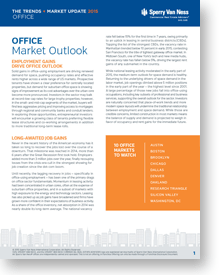
SVNIC’s 2016 Market Outlook Reports assess the current state of the national commercial real estate market, and identify micro-trends within specific geographic regions and industries for 2016. Today we are delving into the 2016 Top Office Markets to Watch. Not the largest or the most actively contested markets, the 2016 Office Markets to Watch are each at an important juncture that presents unique opportunities for investment. Together, they reflect the diversity of trends that is driving the economy and commercial real estate performance in markets across the country.
Top Office Market to Watch: San Antonio, TX
San Antonio, like many Texas metros, has experienced significant economic growth with minimal impacts from the past recession. Overall, total employment is at near record highs and unemployment sits at 3.7% as of January ‘16, according to the Bureau of Labor Statistics. The metro’s diversified economic base from trade and manufacturing to research and finance has left the office market relatively healthy and poised to grow in 2016 and beyond. All key office sectors are growing, including Financial Activities, Professional and Business Services, and Information, at annualized rates of 2.1%, 2.0%, and 1.0%, respectively. San Antonio does have significant exposure to industries such as automobiles and energy that could come under pressure in continued global slowdowns, but overall the risk to the office market does not appear significant at this time.
Stay Updated…
Over the next few weeks, the SVN Blog will be featuring posts that will focus on each of the top markets to watch for industrial, multifamily, office, and retail properties. SVN Advisors from selected top markets have provided their industry expertise regarding what to look out for in their specific market in the coming months. Don’t miss out on these important insights – subscribe to the SVN Blog on the right side of the blog homepage.
To read more on other top office markets, download the full version of the 2016 Office Market Outlook report here.

[bctt tweet=”San Antonio, TX is one of 2016’s top office #CRE markets to watch.” username=”svnic”]
 Houston is the hub of oil and energy production in the United States and, as such, is uniquely susceptible to the recent oil price declines that appear to have near-term persistence. It is likely that the office market in Houston will experience some pain in 2016 and beyond on a relative basis. Declines are already being felt in key office sectors with Information and Professional and Business Services declining at -2.5% and -1.8% annualized rates, respectively; however, Financial Activities is growing at 2.0% and thus should balance some of the negative effects. Overall, the Houston economy is actually fairly healthy with a 4.8% unemployment rate as of January ‘16 which has stayed near constant for much of 2015; thus, fears of the oil price declines may be overblown.
 Dallas remains one of the fastest growing employment centers in the nation, even with the energy price declines of 2015. According to the Bureau of Labor Statistics, the unemployment rate sits near record lows at 3.8% as of January ‘16, with the city creating over a half million new jobs since the recession. The office markets have fared well, as key office sectors of Financial Activities and Professional and Business Services have grown at strong annualized rates of 4.8% and 2.3%, respectively. Information has remained fairly flat at 0.4% annualized growth. As Dallas has become a modern international city with the help of the DFW airport, it is perhaps the best positioned market in the oil-producing region of the U.S. to weather any pain from the petroleum industry. The office market should remain stable and growing in 2016 and beyond.
 The Dallas economy remains one of the strongest of the major metros in the nation with unemployment at 3.8% as of January ‘16 and steadily rising total employment at a 3.4% annualized rate, according to the Bureau of Labor Statistics. The fastest growing sector of employment in Dallas is an industrial space using Trade, Transport, and Utilities, which is growing at an annualized rate of 5.2%. This is the sector, where most of the 2016 and beyond gains in the industrial space market will be generated. Dallas has unparalleled airport and rail access making it an ideal business and distribution hub. In fact, the area surrounding the DFW airport is best poised to expand. Manufacturing is the weakest sector declining at a –1.6% annualized rate. This sector touches oil and gas production and exploration, and is thus most at risk for declines in 2016 and beyond.
 Retail real estate should perform well in Austin in 2016 and beyond, as this dynamic economy continues to grow and diversify. According to the Census Bureau, the population of Austin has grown 12.5% from 2010 to 2014. Not surprisingly, the economy looks stellar with a 3.2% unemployment rate as of January ‘16 and jobs are growing at 4.7% annually, according to the Bureau of Labor Statistics. The best sectors for job growth are Mining, Logging, and Construction and Leisure and Hospitality, growing at 11.0% and 9.2% annualized rates, respectively. These forces will keep new residents locating in the metro region and businesses expanding. Retail demand will follow the population and should continue expanding in 2016 with ever-increasing fundamentals.